
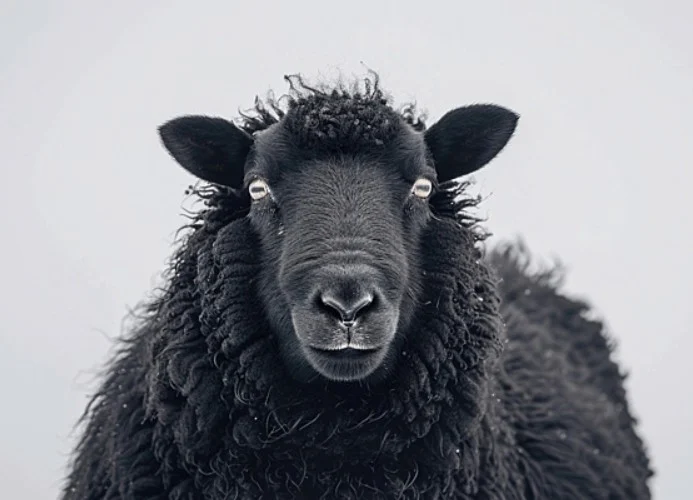
… you need to divide humans into two broad categories: the harnesser — a term I coined — and the herd. Notice that one can be both singular and plural, while the other is always plural. This is natural, as 99% of humanity is driven by herd instincts. They have consistently surrendered their critical faculties to accommodate the herd and find “safety” in their respective comfort zones. Those safe zones are now being obliterated by AI and many are sleepwalking into a future which has no place for them. This presages massive social upheavals. Globalist movers and shakers foresaw this specter long ago, which is why they commissioned “futurists” like Yuval Noah Harari to enunciate a mass, opiated future for so-called “useless eaters.”
The harnesser, by contrast, is far more than a critical thinker. They can turn an impossible situation into a creative opportunity. Think of a sailor catching the wind in his sails and cutting through stormy waters. The harnesser has cultivated, often over decades, the trait of sailing against the current. They have neuroplastically conditioned themselves to question everything. The harnesser also applies a systems approach to problems; grasps complexity with ease; and may possess an uncanny repertoire of knowledge. Their interaction with generative AI is not a one-sided copy-and-paste exercise. They will interrogate and even correct it. Their tacit knowledge – diverse, refined, and somewhat inscrutable – remains beyond AI’s reach.
The cohort that benefits most from generative AI are those educated before the mass-Internet era. It sounds paradoxical, but that generation had to read books and journals, scrounge for information, and cultivate a regimen for inquiry. Most “harnessers” hail from this group and they are dying out.
It is easy to blame AI for “dumbing down” society, but in truth, society was already hopelessly dumbed down. Just look at the quality and theatrics of politicians today, especially in the West. More ominously, their successors are little more than parrots reciting scripts. Can anyone take them seriously, with their sensitivities as fragile as eggshells? AI is not the cause of this decline; it is merely an accelerant. Thanks to decades of trickle-down bad governance dressed up in technocratic jargon, the younger generation is not being taught how to harness AI. This does not augur well for humanity. What will the young people of today do tomorrow?
Worse, the herd is dumbing down AI itself. Generative AI thrives on feedback loops. If each cycle grows dumber, what happens to AI in the long run? Threats related to AI and humans cut both ways. There are also elements of addiction and dependency in the context of AI relationships, as virtual companions are designed to be endlessly available and affirming. This bypasses the growth and friction of genuine relationships, reinforcing escapism. Artificial bonds therefore become a substitute for human connection.
Do AI relationships constitute a psychological disorder, or is society itself a mental asylum? In my view, the two cannot be separated: you cannot study and label the former without acknowledging the pathology of the latter. Clinical language already exists for paraphilias involving attachment to inanimate objects. These include agalmatophilia (attraction to statues or mannequins), objectophilia (a broader category), and, more specifically, pygmalionism – the condition of “falling in love with an object of one’s own creation.”
The term comes from Greek mythology, where Pygmalion was a sculptor who fell in love with a statue he had made. In the modern era, George Bernard Shaw’s play Pygmalion reimagined the myth, transforming an underclass flower girl, Eliza Doolittle, into an object of refinement. What appeared to be an innocent stroke of genius becomes more unsettling when one recalls that Shaw himself openly advocated for mass population culling based on perceived “unworthiness.” Sound familiar?
Also refer ‘AI may become judge, jury and executioner’ – global risks expert to RT [C3]