

The AMA was a weak organization with little money and little respect from the general public when George H. Simmons took the reign of the AMA in 1899. The advertising revenue from its medical journal was a paltry $34,000 per year. Then, Simmons came up with the brilliant idea to transform the AMA into a big business by granting the AMA’s “seal of approval” to certain drug companies that placed large and frequent ads in JAMA and its various affiliate publications. To get the AMA’s “seal of approval,” a drug company did not have to conduct any research nor did they even have to prove the safety or efficacy of a drug. The drug companies simply had to do two things:
- They had to divulge the specific constituents of their drug (no “secret” formulas were allowed…and this action was a beneficial action), however, to get the “seal of approval,” drug companies had one other important requirement…
- They were required to advertise in every local, regional, and national AMA publication (i.e., the drug companies were forced to pay the AMA a large amount of money)
By 1903, the AMA’s advertising revenue increased substantially to $89,000, and by 1909, JAMA was making $150,000 per year. In 1900, the AMA had only 8,000 members, but by 1910, it had more than 70,000. This substantial increase in advertising revenue and membership was not the result of new effective medical treatments, for there were virtually no medical treatments from this era that were effective enough to be used by doctors today or even just a couple of decades later.
Some critics of the AMA have called their seal-of-approval program a form of extortion because the AMA did no testing of any products and not even require any evidence of safety (Ausubel, 2000). When George Abbott, owner of a large drug company, Abbott Biologicals (known today as Abbott Laboratories), did not provide “blackmail” money to the AMA and when none of his products were granted AMA approval, Abbott went on the offensive. He arranged for an investigation of the AMA president that revealed that Simmons had no credible medical credentials, that he had had sex charges brought by some of his patients, and that he had had charges of negligence in the deaths of others.1 After this meeting, the drugs made by Abbott Laboratories were regularly approved, and the company was not required to place or pay for any ads.
In 1924, Simmons was forced out of the AMA due to the many scandals around him, and he took home all his personal files and burned them (Fishbein, 1969, 93). Simmons was wise enough to have trained his replacement, Morris Fishbein. Fishbein’s specialty was publicity and the media, and he used the media to attack anyone who provided a real or perceived threat to conventional medicine. He called chiropractic a “malignant tumor,” and he considered osteopathy and homeopathy “cults.”
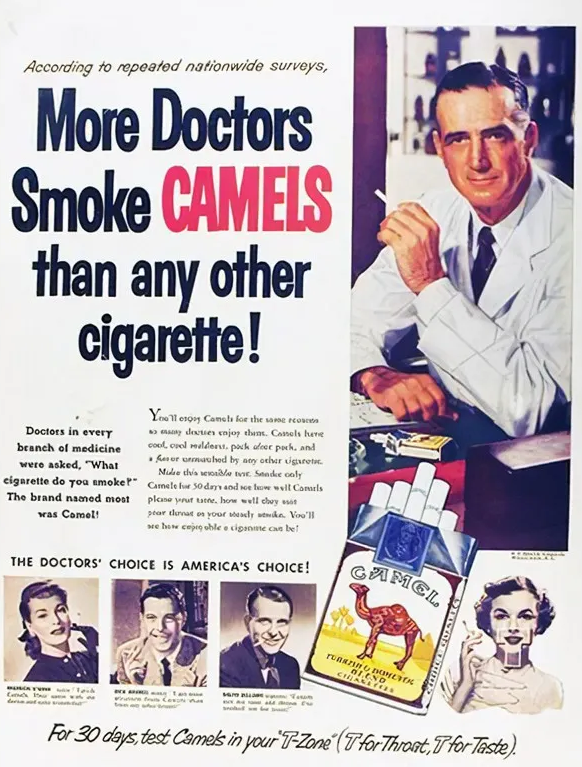
Fishbein extended Simmons’s idea for the AMA seal of approval to foods, and by including a significant amount of advertising from food and tobacco companies, he was able to make the AMA and himself exceedingly rich. In fact, under his reign, the tobacco companies became the largest advertiser in JAMA and in various local medical society publications.
In fact, Fishbein was instrumental in helping the tobacco companies conduct acceptable “scientific” testing to substantiate their claims. Two of the ad claims that Fishbein approved for inclusion in JAMA were: “Not one single case of throat irritation due to smoking Camels” and “More doctors smoke Camels than any other cigarette.” By 1950, the AMA’s advertising revenue exceeded $9 million, thanks in great part to the tobacco companies.
Coincidentally, shortly after Fishbein was forced out of his position in the AMA in 1950, JAMA published research results for the first time about the harmfulness of tobacco. Medical student Ernst Wynder and surgeon Evarts Graham of Washington University in St. Louis found that 96.5 percent of lung cancer patients in their hospitals had been smokers.
Very shortly after the Morris Fishbein left the AMA, he became a high-paid consultant to one of the large tobacco companies, and JAMA finally was able to publish a slew of studies that confirmed the real dangers of tobacco.
Born in 1839, John D. Rockefeller would go on to become one of the great robber barons and industrialist tycoons of American history. By the turn of the 20th century, Rockefeller controlled 90% of the oil refineries in the US through his company Standard Oil, becoming in the process America’s first billionaire. Of course, in 1911, Standard Oil was ruled by the US Supreme Court to be an illegal monopoly in violation of antitrust laws and forced to break up. At the time, chemicals made from oil, known as ‘petrochemicals,’ were being discovered and developed in the US. This included the discovery that pharmaceutical drugs could be made from oil, which Rockefeller saw as an opportunity to expand his empire. The key was that petrochemicals, unlike natural health remedies, could be patented, presenting an enormous opportunity for Rockefeller profits.
There was only one problem – at the time, natural, herbal, and traditional medicines were very popular in the US. Something like half of the doctors and medical colleges in the country were using holistic medicine, natural remedies, and knowledge taken from Indigenous Native Americans. Rockefeller needed a way to eliminate the competition, to create a monopoly in medicine as he had done with oil. And so, he went to his good friend Andrew Carnegie, another robber baron who had gotten rich through his monopoly of the steel industry and, incidentally, one of the country’s leading eugenicists. Together, the two men hatched a plan to take over American medicine.
From the cover of the Carnegie Foundation, they would send a man named Abraham Flexner around the country to report on its medical colleges and hospitals. After visiting all 155 medical schools existing at that time in the US and Canada, he completed the seminal Flexner Report in 1910. Following the directions of his employers, Flexner called in his report for a total restructuring of the American medical system, most specifically, for the pushing aside of natural and traditional remedies in favor of Rockefeller pharmaceuticals. The report even specifically mentioned the eradication of “dissidents,” appropriately, since this is exactly what happened.
Almost immediately after the report was issued, medical schools teaching things like naturopathy, homeopathy, electromagnetic field therapy, and so on, were told to drop these things or close. More than half of all medical colleges in the country did close, and many non-compliant doctors were demonized and even jailed. But Rockefeller and Carnegie went further, offering huge grants to medical schools and hospitals so long as they only taught and practiced Rockefeller medicine, and allowed Rockefeller agents on their boards of directors to ensure compliance. It was the carrot and the stick – those who agreed got funded with big money, those who didn’t were crushed.
Rockefeller went further in seeking to consolidate his control. He took over the AMA and emboldened it as the gatekeeper of scientific thought and witch hunter of alternative medical practices. He took control of the FDA in order to control the approval process for new drugs. He even founded the American Cancer Society in 1913. Within a few short years, Rockefeller was in total control of the American medical system in both thought and action. The result of this takeover, the product of this monopolist son of a conman and his eugenicist partner, would become known as “Big Pharma.”
That Big Pharma took over and monopolized American medicine, promoting their own patented, profit-making products and suppressing all others, isn’t even a conspiracy theory. In fact, it was recorded for all to see in 1953. In the early 1950s, US Senator Charles Toby enlisted an investigator with the Interstate Commerce Commission named Benedict Fitzgerald to examine allegations of conspiracy and monopoly in medicine. Toby had become interested in the issue after his own son had gotten cancer and been given less than two years to live by orthodox medicine before pursuing alternative treatments and being cured. The resulting 1953 report, known as the Fitzgerald Report, was truly shocking. It concluded that Big Pharma had been involved in “a conspiracy of alarming proportions.”2
First, there was “The organized effort to hinder, suppress and restrict the free flow of drugs which allegedly proven successful in cases where clinical records, case history, pathological reports, and x-ray photographic proof, together with the alleged cured patients, are available.” On top of that, “Public and private funds have been thrown around like confetti at a country fair to close up and destroy clinics, hospitals, and research laboratories which do not conform to the viewpoint of medical associations.”
The report even noted that Big Pharma had conspired to suppress at least 12 promising cancer treatments. It was an unfathomably damning report, making clear that the tentacles of a Big Pharma conspiracy to suppress alternative medicine were everywhere. One example of this is what happened to Laetrile, a promising cancer treatment and a natural substance (and therefore unable to be patented) that the Sloan-Kettering Institute (with three Rockefeller family members on the board) found to be worthless despite numerous suppressed lab reports.3 4 Much like happened to ivermectin in covid times, the expensive, synthetic drugs win out regardless of any risks to health.
- A respected physician-urologist who was an alumni of Rush (Medical College) uncovered death certificates and prescriptions that Simmons wrote in Nebraska during every week over the six-month period that Simmons was supposedly attending classes in Chicago, more than 500 miles away (Lydston, 1909) ↩︎
- http://www.newmediaexplorer.org/chris/2007/04/03/1953_fitzgerald_report_suppressed_cancer_treatments.htm ↩︎
- http://www.jaegerresearchinstitute.org/articles/laetrile.htm ↩︎
- https://www.midwesterndoctor.com/p/the-century-of-evidence-putting-light ↩︎