

What is money?
Historically, only gold and (often) silver have been real money, broadly accepted as a means of exchange that carries no counter-party risk to the holder. All currencies used throughout history that were not backed by gold – meaning you could exchange your “cash” paper for its equivalent in gold (or silver) – were no more than a promissory note. A promise by the government (or any organisation creating the cash) that its value could be used to buy something. These are called fiat currencies, which is all we have since the US dollar was removed from the gold standard in the early 1970s. This is no different to credit, where another party has a (counter) interest in what you hold.
Risks to cash (fiat currency) include inflation, economic collapse and/or governmental failures or currency devaluation policies, especially during a trade war.
For example, $1 in 1970 is equivalent in purchasing power to about $8.29 today, an increase of $7.29 over 55 years. The dollar had an average inflation rate of 3.92% per year and people today have about 72% less purchasing power than in 1970. This is why we now have many more double income families, are paying much higher taxes and have wages not keeping up with inflation and the cost of living, especially in food and housing.
This is not by accident or through bad luck. Inflation is just another tax. Taxes were “created” to pay government debt.
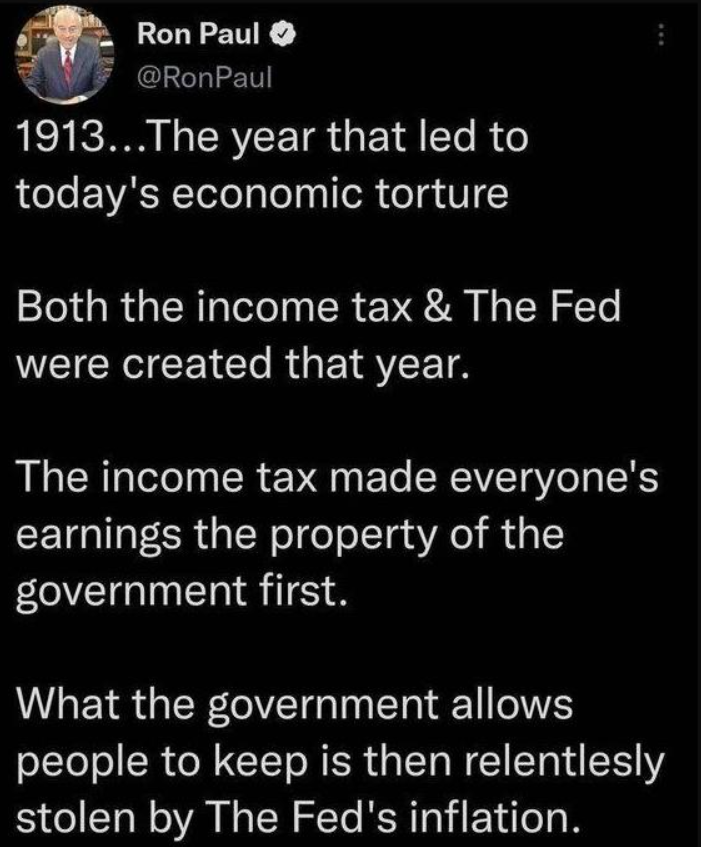
The same process applies to those governments that need to borrow money to pay interest. For example, the US government currently owes over US$36 trillion with an annual interest bill of US$1 trillion plus, paid for by taxes. All this interest goes to those who create (and lend out) the money in the first place, such as the national banks like the Federal Reserve in the US that are privately owned by the cult and its agents. Of note, the Federal Reserve and Income Tax came about in 1913 as a result of bankers’ (including the Warburgs) negotiations with the US government. The current system with the US dollar as the world’s reserve currency was created at the end of WW2, with Bretton Woods.1
The US convened the international conference at Bretton Woods, New Hampshire, on July 1-22, 1944, which then established the supremacy of the American dollar as the basis for post-war international trade and commerce. Bretton Woods was a huge step in the direction of American global hegemony, because where the dollar went, military force would follow. The US had the power to create the Bretton Woods system because US allies had sent most of their gold to America to pay for weapons purchases: the US at the time controlled seventy percent of the world’s monetary gold. The Bretton Woods system established the US$ as the benchmark for international monetary transactions. Since every nation would be expected to hold a substantial dollar reserve, they could get dollars through trade or by borrowing from US banks. Borrowing could be done directly from the banks or through an intergovernmental organization, like the International Monetary Fund (IMF).
The IMF would become one of the key instruments of international political control, a role it continues to play today. The IMF has lent to dozens of nations around the world, especially those from the “Global South” with financial problems. Whenever a nation seeks its help, the IMF insists it undertake “free market reforms,” which in actuality means selling off its publicly owned utilities and industries to the big US and international banks and corporations while its population languishes in destitution. The IMF also requires the borrowing nations to allow Western banks and corporations to take over and exploit each nation’s mining, agriculture, and other industries so that they can earn enough income from selling their products abroad to repay IMF loans. Countries under IMF control gradually lose the ability to have a sustainable economy and policies promoting domestic well-being. It’s neocolonialism or even imperialism, making the IMF the world’s greatest loan shark.2
With the dollar triumphant, the US initially had no need to borrow from the IMF or anyone else. Instead, Federal Reserve interest rates would determine the amount of money available for trade, created as always through fractional reserve lending. Later, this would be used to finance the growing US trade deficits through the sale of Treasury bonds to foreign nations. It would also pay for the growth of the US military machine’s hundreds of foreign bases.
Eventually, Federal Reserve “money printing” may well backfire. Today, with the US weaponisation of the dollar – through sanctions, seizures and restriction of access to financial trade systems – and Russia, China, and other nations leading the charge against the dollar as a reserve currency, the entire system is poised to blow up with hyper-inflation. The US population (already) can scarcely afford to buy a home, a car, or food.3 In 2025, President Donald Trump, faced with the emerging BRICS alliance, declared that any nation seeking to replace the dollar with trade in their own currency would be committing an act of war against the US. This is happening anyway. The death knell sounds.
Also refer From Dollar Bomb to Crypto Trap: Putin’s Advisor Exposes Washington’s New Financial Weapon [C3]
When Anton Kobyako, special advisor to Russian President Vladimir Putin, accused Washington of employing stablecoins and gold to wipe out its staggering $37 trillion debt “at the world’s expense,” (as he did in 2025) his statement might have sounded conspiratorial to the casual observer. Yet, upon closer inspection, it is far from irrational. In fact, Kobyako’s blunt assessment sheds light on how the US is weaponizing not just the dollar but also the emerging world of crypto finance, thus reinforcing its global dominance in a novel fashion. [Desperate measures? American currency as the “dollar bomb”.]4
More specifically, Kobyako argued that the United States has devised a scheme whereby stablecoins — digital assets pegged to “stable” reserves like the dollar — can be manipulated to devalue America’s debt obligations. By engineering market instability, Washington allegedly aims to shift financial burdens outward, leaving the rest of the world footing the bill. Stablecoins are often presented as safe harbors within the volatile crypto ecosystem, serving as digital equivalents of fiat. But as Kobyako suggests, their very design makes them tools of leverage in global financial warfare.
An Example of the Power of Debt:
As described in ‘The True History of World War II‘ by Ron Unz, there exist countless starting points for those who seek to discover the true history of WW2. He states that one of the best of these comes in a relatively short book published in1961 by A.J.P. Taylor, a renowned Oxford historian, with the title of ‘The Origins of the Second World War‘. In that book, Taylor laid out a case for how the conflict began that is radically different from what has been portrayed in the cult owned media (and entertainment) industries for over 80 years. According to Taylor only a dreadful “diplomatic blunder” by the British had led the Poles to refuse Germany’s demand for the return of Danzig, a border city under Polish control that had a 95% German population, which overwhelmingly desired reunification with its traditional homeland after twenty years of enforced separation following the end of the First World, with many German citizens suffering attack.5 [Shades of Ukraine today]6
With many millions of his books in print, including a string of bestsellers translated into numerous languages, David Irving ranks as one of the most internationally-successful British historians of the last one hundred years. Whereas Taylor (and others) demonstrated that the decisions taken by the British government had provoked the Second World War, Irving’s archival research uncovered some of the sordid reasons that some British officials had taken the actions that they did. In 1987 Irving published the first volume of “Churchill’s War“, and his exhaustive archival research produced huge revelations regarding the character of that historic figure, demonstrating the latter’s tremendous venality and corruption. Churchill was a huge spendthrift who lived lavishly and often far beyond his financial means, employing an army of dozens of personal servants at his large country estate despite frequently lacking any regular and assured sources of income to maintain them. This predicament naturally put him at the mercy of those individuals willing to support his sumptuous lifestyle in exchange for determining his political activities.
To put things in plain language, Irving stated that during the years leading up to the Second World War, both Churchill (and numerous other fellow British MPs) were regularly receiving sizable financial stipends—cash bribes—from (cult) sources in exchange for promoting a policy of extreme hostility toward the German government and advocating for war. The sums involved were quite considerable, including payments that amounted to tens of millions of dollars in present-day money to British elected officials, publishers, and journalists working to overturn the official peace policy of their existing government. A particularly notable instance occurred in early 1938 when Churchill suddenly lost all his accumulated wealth in a foolish gamble on the American stock-market, and was soon forced to put his beloved country estate up for sale to avoid personal bankruptcy, only to quickly be bailed out by a foreign millionaire intent upon promoting a war against Germany.
During the late 1930s, Churchill and his clique of similarly bought-and-paid-for political allies had endlessly attacked and denounced Chamberlain’s government for its peace policy. Eventually, these accumulated pressures forced Chamberlain into the extremely unwise act of providing an unconditional guarantee of military backing to Poland’s irresponsible dictatorship. As a result, the Poles then rather arrogantly refused any border negotiations with Germany, thereby lighting the fuse that eventually led to the German invasion six months later and Britain’s subsequent declaration of war. Irving’s 1987 book on Churchill laid bare his subject’s extremely lavish lifestyle as well as his lack of any solid income, along with the terrible political consequences of that dangerous combination of factors.
This shocking historical picture was fully confirmed in 2015 by a noted financial expert whose own book focused entirely on Churchill’s tangled finances, and did so with full cooperative access to his subject’s family archives. The story told by David Lough in “No More Champagne” was actually far more extreme than what had been described by Irving almost three decades earlier. Lough explained that Churchill became prime minister on May 10, 1940, the same day that German forces began their invasion of the Low Countries and France. But aside from those huge military and political challenges, Britain’s new wartime leader faced an entirely different crisis as well. He found himself unable to cover his personal bills, debt interest, or tax payments, all of which were due at the end of the month, thereby forcing him to obtain a huge secret payment from the same businessman who had previously rescued him financially. Churchill’s debts and reliance on a wealthy benefactor are today replicated in the US by cult influence over Trump, the US government and across ‘western’ allied nations. [Shades of Miriam Adelson and the Gaza genocide today.]7
Windows to Usury and to our Decline
The Roaring Twenties and the Depression [C3]
On March 4, 1933, Roosevelt was inaugurated. Six days later, by executive order, he took the US off the gold standard. Now, no one, other than a Federal Reserve bank, would even be allowed to hold gold or gold certificates except for up to $100 for use in the arts or collectibles. Those who say the US never defaulted on its debt are wrong in that in 1933 and again in 1971 the US suspended gold convertibility of cash assets held by depositors in the US and abroad. Creditors could get paid by paper or credit transfers but not in hard currency. The elimination of gold-based currency was another step in depriving the US public of purchasing power not dependent on borrowing from the banking system.
US Dollar – On the Petrodollar System [C2]
The finance industry was, by far, the biggest beneficiary of the ‘petrodollar system’ [1971-72]. The manufacturing sector, along with its union workforce, was the biggest victim. The collapse of America’s manufacturing heartland into the wasteland we call the Rust Belt was directly caused and exacerbated by the petrodollar system. Viewed as a whole, then, the petrodollar system was incredibly beneficial for (a) commercial and global banks, (b) arms manufacturers, (c) real estate owners, and (d) stockholders. For everyone else, the petrodollar system turned out to be a Trojan Horse, a promising gift that destroyed the recipient.
The Myth That the US Is Rapidly Approaching Bankruptcy [B2]
For every debt, there’s somebody holding that debt for whom it is an asset, and they want to protect their assets. They don’t want there to be a risk that the United States [read ‘any’] government will stop paying interest on the debt. So the government’s pledge to them, unspoken but very real, is don’t worry, we will cut back on everything to the people to preserve your interest in getting paid off for that debt that you own and that you invested in. You rich people, you potentates around the world ripping off your own populations and investing it in dollars. Yeah, yeah, yeah. We’ll protect you who don’t elect us but who fund us. And we will screw the people because you elect us but you don’t fund us. We’re told, gee, we’ll have to cut public services so we don’t mess up the budget.
The Bread, the Circus, and the Sugar Water [B2]
We had stumbled into the fundamental reality of fiat systems: they appear to offer choice while constraining all possible outcomes within predetermined parameters. The same mechanism that allows central banks to create “money” from nothing while maintaining the illusion of scarcity, that permits pharmaceutical companies to create diseases in order to sell cures, that enables media corporations to manufacture consent while claiming to report news.

Multipolarity: A World Reborn [F3]
“When I was your age, life for British people was getting better every year. Now, one in five people (14 million) live in poverty, and it’s been getting worse for 20 years. The richest 50 families own more than half of the population [does].” The Joseph Rowntree Charitable Trust says that UK income inequality is among the highest in the developed world.
With the UK economy facing fresh trade threats and public spending under strain, households may feel the impact as market jitters persist, and interest payments rise. Chancellor Reeves has been criticised by her rival Sir Mel Stride MP, who accused her of “economic mismanagement” and warned that “families will pay the price”. The Shadow Chancellor said:
“Britain now has the third-highest deficit and the fourth-highest debt burden in Europe, with borrowing costs among the highest in the developed world... Under Rachel Reeves’s economic mismanagement and Keir Starmer’s weak leadership, our public finances have become dangerously exposed — vulnerable to future shocks, welfare spending rising unsustainably, taxes rising to record highs and crippling levels of debt interest. Labour’s recklessness risks it all — your pension, your job, your savings, your home.”
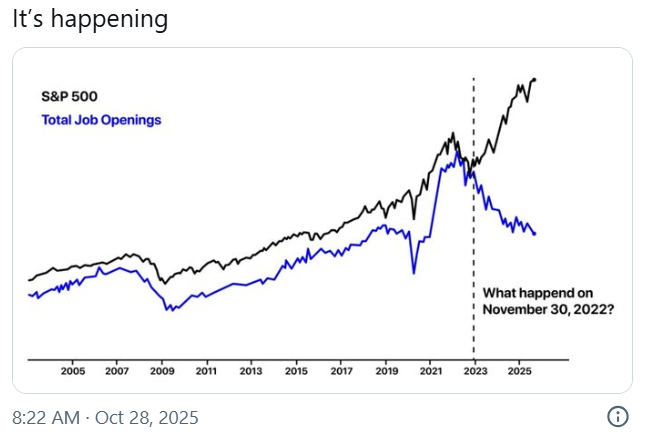
Also refer It’s Here. AI Has Already Put 300 Million Jobs At Risk: What Next? (C3]
According to McKinsey’s 2025 analysis, 8 million workers in the UK will be affected by artificial intelligence by 2030, amounting more than a quarter of the current national workforce. Of those, 3.5 million could experience complete job displacement, with the rest seeing “significant task disruption”.
Notably, McKinsey’s report projects that the most affected groups will be women, young people, and lower-income workers, due to their saturation in fields such as retail, clerical support, and hospitality. [More “buy now, pay later” for groceries. Who can afford a mortgage?] Grocery prices have tripled for many people in the US.8 In two years!
Once a theoretical risk, we’re now seeing real-time restructuring. Writers, junior developers, support agents, and administrative assistants are already being replaced partially or completely by automation. And this is just the beginning. What happened on 30 November 2022? –> [Think the launch of AI]
The corporations which are building properties for rent lobby the government to increase migration, creating a new housing crisis, which the lobbyists then use to remove more private ownership of property by building properties just to rent. Using immigration, they have found a way to create a permanent crisis for which their solution, so they will tell you, is required. The Australian government has announced that it wants to import 13.5 million migrants by 2065, averaging 235,000 additional migrants each year. That’s enough immigrants per year to keep the housing crisis scam going for the next 40 years. This scam is not only affecting Australians; it is a global affair. The same scam is operating in the UK and the US. The best way to force you out of your home is with increased land taxes, rates and insurance levies that go up each year with inflation and must be paid forever, like rent on something you already own. [and estate taxes]
In the U.S. there is no political party which effectively represents the working class and the nationally oppressed. The economic policies of both the Democrats and Republicans have only lowered the standards of living among the majority of people living inside the country. The arduous task of building a party of the proletariat and the oppressed provides the only glimpse of hope for reversing the current situation. Such a formation would be positioned to fight back against the deliberate worsening of conditions for the people, the imposition of fascism and the heightened threats of imperialist war.
In the South, is there really a debt crisis? [C2]
According to economist Michael Roberts, referring to the report that Oxfam published on January 10 on the occasion of the Davos summit:
“Entire countries are threatened with bankruptcy. The poorest countries currently spend four times more to repay their debts to the rich than they spend on healthcare. Three-quarters of the world’s governments foresee reductions in public spending linked to austerity – including in the areas of health and education – reaching $7.8 trillion over the next five years.“
The ‘banked’ road to slavery
Quotes on Economics and Banking You Won’t Hear on Corporate Mass Media [B2]
The modern banking system manufactures money out of nothing. This process is perhaps the most astounding piece of sleight of hand that was ever invented. Banking was conceived in inequity and born in sin.. Bankers own the earth. Take it away from them but leave them the power to create money, and, with the flick of a pen they will create enough money to buy it back again… if you want to continue to be the slaves of the bankers and pay the cost of your own slavery, then let bankers continue to create money and control credit. – Sir Josiah Stamp, Director of the Bank of England and the second richest man in Britain in the 1920s.
“The goal is control. They want all of us enslaved to debt, they want all of our governments enslaved to debt, and they want all of our politicians addicted to the huge financial contributions that they funnel into their campaigns. Since the elite also own all of the big media companies, the mainstream media never lets us in on the secret that there is something fundamentally wrong with the way that our system works.” – Karen Hudes (worked in the legal department of the World Bank for more than 20 years and was Senior Counsel when she was fired for blowing the whistle on the corruption).

The Modern Slave [B2]
… earn money, pay income tax; own property, pay property tax; spend money, pay sales tax; save money, lose to inflation tax; invest successfully, pay capital gains tax; start a business, pay for licenses; run a profitable business, pay corporate tax; give money away, pay gift tax; die with assets, pay inheritance tax. Every economic action becomes a revenue opportunity for the system that owns your labor. You can’t opt out of funding wars you oppose, surveillance systems that monitor you, or bureaucracies that regulate your choices. Your ‘property’ can be seized for unpaid taxes, even if you own it outright. Historical slaves at least knew they were enslaved. The violence was visible, the coercion obvious, the enemy identifiable. Today’s slaves are convinced they’re consumers. But here’s the real masterpiece: you’ve been convinced this is freedom. [just poorer for it]
A Short History of Bubblenomics [B2]
Sound familiar? Flat wages, weak demand, slow growth and more and more debt? All signs of an aging, hobbled system that’s slipping inexorably into stagnation. This is why the Fed adopted its present policy of bubble making, because the only way to avoid stagnation is by increasing the debt-load. Authors John Bellamy Foster and Fred Magdoff traced the origins of the policy back to the 1970s. They revealed their findings in an article in The Monthly Review titled “Financial Implosion and Stagnation”.
Global Crisis, National Renewal: A (Revolutionary) Grand Strategy for the United States [B3]
Viewed through the geopolitical filter, states fail as a result of war, conquest or bolts from the blue such as pandemics or drought. But if we remove this filter, we find that the decay [or upheaval] of the domestic economic, political and social orders is the decisive factor. States fail when the domestic economy no longer generates enough surplus to fund the state and the parasitic elites that have come to dominate the state.
Measured human consequences synchronous with the post-1991 acceleration of globalization, mainly affecting the lower-income classes, in the West, include: loss of welfare safety net, increase of number of single-parent families, threefold increase in rate of confrontational litigation in the courts, between parents and between individuals and with the state (“crisis in access to justice”), increased low-income household basic-need incidence (housing, health, safety, work, finance), increased rates of both suicide and suicide attempt, increased rate of opioid overdose (preceding the opioid epidemic of the 2010s), and increased rates of chronic asthma emergencies, and asthma prevalence, in both children and adults.
Confessions of an Economic Hit Man [B2]
Today we see the results of this [imperial dollar] system run amok. Executives at our most respected companies hire people at near-slave wages to toil under inhuman conditions in Asian sweatshops . Oil companies wantonly pump toxins into rain forest rivers, consciously killing people, animals, and plants, and committing genocide among ancient cultures . The pharmaceutical industry denies lifesaving medicines to millions of HIV-infected Africans. Twelve million families in our own United States worry about their next meal. [by John Perkins – very informative on ongoing strategies for US hegemony]
Investment Banker / Economist, Catherine Austin-Fitts Explains The Great Poisoning [B2]
There are many examples who I met personally and I was frequently horrified, from dealing with human trafficking victims to individuals with terminal disease lying on dirt floors whilst their only “carer” was forced to leave the home to search for a daily income in order to afford pain medication OR food (whichever seemed most important on any given day). A significant proportion of the population are enslaved by a lifetime of unpayable debt. This was when I learned that powerful people claiming to hold humanitarian values, in fact do not value human life and do not care about human suffering.
Sickening Profits: The Global Food System’s Poisoned Food and Toxic Wealth [C3]
… BlackRock and others are not just heavily invested in the food industry. They also profit from illnesses and diseases resulting from the food system by having stakes in the pharmaceuticals sector as well. A win-win situation. The book goes on to describe how lobbying by agri-food corporations and their well-placed, well-funded front groups ensures this situation prevails. They continue to capture policy-making and regulatory space at international and national levels and promote the notion that without their products the world would starve. Moreover, they are now pushing a fake-green, ecomodernist narrative in an attempt to roll out their new proprietary technologies in order to further entrench their grip on a global food system that produces poor food, illness, environmental degradation, the eradication of smallholder farming, the undermining of rural communities, dependency and dispossession.

The Economy-and its Future-in Four Charts [C2]
The gains from rising productivity–the only durable source of prosperity–were shifted from wages to owners of capital. As wages lost ground, the central bank (Federal Reserve) replaced cash earnings with debt, by:
- lowering interest rates for 40 years;
- increasing the money supply [inflation]; and
- opening the floodgates of credit.
Wage earners used credit to pay expenses, the wealthy used credit to buy income-producing assets. As a result, assets such as houses are now unaffordable to all but the wealthy. The net result of these dynamics is the rich got much, much richer, and wage earners became debt-serfs paying interest to the wealthy owners of their debts. People are now using ‘Buy Now, Pay Later’ for groceries…
Also refer Small Business at the Heart of Australian Prosperity [B2]
“Australian small businesses are the heart of every community, employing more than 5 million people. Yet, they are struggling to manage spiraling business costs. Small business needs a future of stability, growth, and success for the benefit of every Australian. Small businesses have been hard hit over the past year, with nearly half not breaking even. Owners are doing their best to keep their heads above water, but this is not an easy task in a sea of economic and regulatory uncertainty.”
People that rely on wages or business income are going backwards unless they have other investment assets. This includes small business owners and their employees. Further increases in taxation and other costs, including in the cost of living, may see many small businesses forced to close. … nearly one in three small business owners are already unable to pay themselves.
The Golden Rule: He who has the Gold, makes the Rules
Why No Pure Fiat Currency Has Ever Survived More Than 100 Years [C3]
[currencies] have seen significant devaluation. The U.S. dollar, for instance, [unlike gold] has lost over 97% of its purchasing power since the Federal Reserve was established in 1913. What once bought a new tailored suit now barely buys a fast-food meal. If history is any guide, we are living on borrowed time with today’s fiat currencies. With unprecedented levels of debt, massive money printing, and growing geopolitical instability, the question isn’t if fiat currencies will fail but when. Even central banks seem to recognize this risk. Why else would they be stockpiling gold at record levels?
Understanding the War on Cash [B2]
Journalist and former broker Brett Scott spoke to financial platform The Motley Fool about who wins and who loses in a cashless scenario, and why cash matters. Scott acknowledges the convenience of digital payments, but argues that cash remains essential thanks to its unrivalled resilience. Should power or internet connectivity be lost—either due to a temporary glitch or a longer-term problem such as a natural disaster—payments that depend on such infrastructure become unusable. Cash can be used as a transfer of value. [although gold is more resistant to inflation]
“I might find it useful to use an elevator to get to the top of a skyscraper, but that doesn’t mean I want the emergency stairs removed. In many senses, cash is like emergency stairs: the resilient payment system that doesn’t go down when the hurricane hits.” [Cash in hand also means no third party is involved in payments]
Also refer The Global War on Cash [B3]
The shots fired by governments to fight its war on cash may have several unintended casualties:
1. Privacy
- Cashless transactions would always include some intermediary or third-party.
- Increased government access to personal transactions and records.
- Certain types of transactions (gambling, etc.) could be barred or frozen by governments.
- Decentralized cryptocurrency could be an alternative for such transactions
2. Savings
- Savers could no longer have the individual freedom to store wealth “outside” of the system.
- Eliminating cash makes negative interest rates (NIRP) a feasible option for policymakers.
- A cashless society also means all savers would be “on the hook” for bank bail-in scenarios.
- Savers would have limited abilities to react to extreme monetary events like deflation or inflation.
3. Human Rights
- Rapid demonetization has violated people’s rights to life and food.
- In India, removing the 500 and 1,000 rupee notes has caused multiple human tragedies, including patients being denied treatment and people not being able to afford food.
- Demonetization also hurts people and small businesses that make their livelihoods in the informal sectors of the economy.
4. Cybersecurity
- With all wealth stored digitally, the potential risk and impact of cybercrime increases.
- Hacking or identity theft could destroy people’s entire life savings.
- The cost of online data breaches is already expected to reach $2.1 trillion by 2019, according to Juniper Research.
Also refer Thailand Freezes Over 3 Million Bank Accounts and Thais Fear Bank Account Freezes Amid Crackdown on Mule Accounts, Survey Finds [both B2]
Thailand has become a case study for the use of biometric data in every facet of life. Every banking transaction is monitored and scrutinized. Any perceived discrepancy is flagged as fraud and punished without due process. Regulations have overwhelmed the system, resulting in a full-fledged banking crisis. Over three million Thai bank accounts were frozen instantaneously without warning as a result of government overreach.
Transaction denied. You contact your bank to see why the payment failed only to learn that your account has been frozen–all of your accounts, for that matter. The bank is investigating you for suspicious activity and potential money laundering or fraud. There was no warning call or letter and there is no clarification as to what transaction was flagged. You’re completely locked out of your accounts and have lost the ability to purchase. You cannot fill your gas tank, you cannot purchase groceries, you’ve been completely removed from the financial system, and do not know when or if you’ll regain access to your funds.
From macro to micro, public to private, the pattern is the same: policy increasingly operates through conditional settlement rather than democratic deliberation. If you lack the right attestation, the transaction doesn’t clear. No compliant credential, no access to markets, services, or money itself.
[Historically value has always been placed in gold in times of crisis. This is because fiat currencies that “vanish” from the related causes of inflation and debt allow holders of gold to buy assets and resources on the cheap. For example, in the 1920s a few ounces of silver could buy you a nice house in Berlin. There is currently a major effort to implement Central Bank Digital Currencies or ‘stablecoins’ as an alternative to cash. This is because control of digital money (tokens) is more efficient, enforces compliance and eliminates the need for messy “boom / bust’ cycles. This makes the elite’s stores of gold an insurance policy (in case ‘tokens’ are rejected by the masses) as well as the likely “variable” control measure of token value. Like an auction where the seller must accept the price set by the purchaser. Win win for our golden banking overlords.]
Also refer A Financial Chronology [B2] for a full $$$ chronology from Pre-Marx Monetary Foundations (c. 1770s–1844) to the current slavery inducing system. In other words, from Early Monetary Architecture to Programmable Settlement [where access to money is everything].
Monetary control has shifted from physical metal to mathematical models to digital metadata — and now policy executes at the speed of light. This infrastructure matters because it’s become a network of conditional switches which you interact with daily: sanctions, card rules, app policies, IDs, nudges, carbon prices, and emergency credentials. These create a programmable boundary that can tighten or loosen access without requiring new laws for every micro-decision. [efficiency]
“Rules are moving inside money itself, justified by alleged morality, enforced through identity, normalised via nudges, and accelerated during crises.“
Seven mechanisms now form this programmable perimeter, each operating through existing infrastructure whilst expanding the scope of financial control. From global sanctions that can isolate entire nations to carbon pricing that influences individual purchases, these systems work in concert to create a comprehensive framework where economic policy can be implemented at the transaction level.
- The global ‘off switch’.
Dollar sanctions and correspondent banking cutoffs work like freezing accounts worldwide; domestically, bank ‘de-risking’ does the same thing to individuals and companies. - Private companies write the rules for everyday payments.
Card networks and app stores already block entire categories, specific vendors, and payment flows — they can even hide or remove the apps you need to pay or get paid. - Your identity controls your access.
Government-recognised digital ID now controls access to bank accounts, SIM cards, travel, government services, and venue entry. Connect your ID to a wallet and policy enforcement happens the instant you spend. - Moral values become hard rules.
Under banners like inclusive and sustainable, corporate boards, banks, and asset managers turn moral claims into requirements for accessing capital, contracts, insurance, and platforms. - Gentle nudges become rigid constraints.
Friendly prompts about carbon footprints, default spending limits, and purchase categories train users to accept pre-transaction checks that eventually become hard rejections, caps, or cooling-off periods. - Policy enforcement at every transaction point.
Carbon border taxes and local low-emission schemes embed environmental scores into prices, delivery fees, and access — policy executes at checkout and customs. - The emergency playbook.
Health passes and crisis dashboards demonstrated how credentials can become tickets for work, travel, school, or shopping; the same machinery can be redirected to new triggers (pandemic, climate, cybersecurity).
These aren’t theoretical systems. Sanctions prove the off-switch works globally. Cards and app stores show private rule-making affects you locally. Digital ID links your person to ledgers. The moral economy narrative makes it feel justified. Nudges acclimatise everyone to transaction-level checks. Carbon pricing welds policy directly into everyday purchases. Emergencies provide the acceleration. [Only strong and resilient nations can survive sanctions. Who can live without access to money?]

How Central Bankers Rule the World [B2]
The intent behind CBDCs is complete control by central banks over populations. The central controllers will decide if, when and how you may spend your money, and can use this monetary control to enforce compliance with any and all global governance agendas.
Also refer The GENIUS Act and National Bank Acts of 1863-64: Taking a Cue from Lincoln [B3 ]by Ellen Brown
The Great Dispossession Part 3 [B2]
The provision of CBDC to the population would provide a money supply and income to a population in total chaos and restore order to a grateful population. But it would also give total control to rulers. Webb quotes Augustin Carstens, general manager of the Bank for International Settlements who says that the key difference between present day currency and Central Bank Digital Currency (CBDC) is that with CBDC the central bank will know how each person uses their allotment of digital currency which gives the central bank absolute control over you via the capability to regulate your purchases, to turn off disapproved purchases, and to discipline dissenters. You will be supplied with the means of life as long as you have a good social credit score, which means that you are a non-dissenter of official narratives. In other words, a slave.
Also refer Can’t Afford a Vacation? Blame the Fed. [B2]
Those of us who know the truth must continue to explain that the solution to our problems is a vacation from the welfare-warfare state and the fiat money system that facilitates government growth at the expense of the people’s standards of living and liberty. Limited government, free markets, and peaceful relations and free trade with as many nations as possible are components of the path to lasting peace and prosperity.
The “End” of Debt becomes you
The … deep state is real; it conspires to benefit global oligarchs at the expense of the public [C3]
The UK policy response to the pseudo pandemic had a hugely detrimental impact of the real economy, which affects most of us. Yet it was a time of unprecedented wealth creation by and for the oligarchs. While every single policy decision increased the mortality risk for all of us, billionaire philanthropists – the “Bill Gates-type people” – never had it so good. It doesn’t really matter which major policy arena we look at. Whether it’s the policy response to climate change or to the energy crisis or to spiraling global debt or to wartime sanctions – or even to war itself – the outcome is always the same. Not sometimes the same. Not occasionally the same. But consistently the same. Oligarchs always amass more wealth, influence, and resultant power via government policy decisions. And, usually, those decisions are made amidst crises.
‘New Wealth of Top 1% Surges by $33.9 Trillion Since 2015 – Enough to End Poverty 22 Times Over’ [B2]
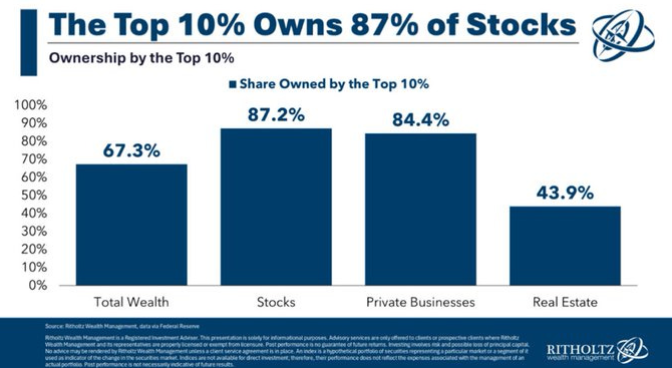
That said, the facts that Oxfam continues to publish (for those who care) have only grown worse. It is one more reason, together with militarism and warfare, genocide and permanent, provocative policies, that will accelerate the decline and fall of the West. Western capitalism has always been and will remain a wealth-creating machine for the few and unspeakable misery for the ‘damned of the earth.’9
The Collapse of Dollar Hegemony Could Lead to World War III [B3]
But all of this [our prosperity] requires a monetary system that supports individual freedom and initiative. We do not have such a system today. What we have is debt slavery where the 1% make out like bandits and the 99% struggle to survive. Such a system also promotes crime and war [violence], where people and nations feel they must steal from their neighbour in order to get by.
Also refer Russia Exposes USA’s $37 Trillion Financial Reset Plan: Here’s How It Will Make You Poor [B3]
A senior Russian presidential advisor, Anton Kobyakov, has suggested [in September 2025] that the USA is planning a quiet but catastrophic escape route from its debt crisis, leaning on crypto, stablecoins, and gold. Currently $37.5 trillion in debt and paying $882 billion per year in interest alone, the US relies on financial engineering to keep the machine running. The reset suggested by Kobyakov would be the largest wealth transfer in history, with the asset-rich gaining extreme wealth while wage workers are plunged into poverty. Remember that this is not a US-specific problem. Stocks, bonds, commodities and trade are still mostly tied to the US dollar, affecting most of the world’s economy. This piece connects the dots between the debt mathematics, the crypto boom, and the proposed policy shift that could reshape generations to come.
So, with the execution of this plan, the largest ever transfer in wealth (from the lower earners and middle class to asset holders) will take place. Elections will not change the outcome here. Governments will continue to focus on self-preservation at whatever cost, and everyone else will foot the bill for the already-rich. Citizens will absorb the cost through inflation, taxation, and tighter monetary control, while the asset-rich (who also happen to sit in governments) escalate their net worth.
The Great Taking [and The Great Taking Exposes the Financial End Game] [both B2]
It is about the taking of collateral, all of it, the end game of this globally synchronous debt accumulation super cycle. This is being executed by long-planned, intelligent design, the audacity and scope of which is difficult for the mind to encompass. Included are all financial assets, all money on deposit at banks, all stocks and bonds, and hence, all underlying property of all public corporations, including all inventories, plant and equipment, land, mineral deposits, inventions and intellectual property. Privately owned personal and real property financed with any amount of debt will be similarly taken, as will the assets of privately owned businesses, which have been financed with debt. If even partially successful, this will be the greatest conquest and subjugation in world history.
The New Eugenics Movement: Part 1 [C3]
… claims that mental defectiveness (which ranged from criminal behaviour, insanity, physical deformities and forms of mental retardation to addictions such as alcoholism and gambling, homelessness, owing massive debt etc. etc.) were all to be considered heritable qualities. Thus, those in possession of such unwanted qualities should be segregated from society or sterilised. He acknowledges that such measures may appear immoral, but that it is only immoral when coercion is used against persons of “normal intelligence,” for those who are deemed abnormal, unable to use reason, such standards of morality do not apply. [Hm, sounds familiar …]
… and so we all do (link) the Usury Dance
- https://www.amazon.com/Our-Country-Then-Richard-Cook/dp/1949762858 ↩︎
- Neo-colonialism refers to the practice of using economic, political, and cultural pressures to control or influence a country, often after a formal colonization period has ended. It often manifests through multinational corporations, foreign aid, and economic policies that benefit external powers at the expense of local economies. Imperialism, in contrast, is a broader concept that encompasses the policy or ideology of extending a nation’s authority through territorial acquisition or establishing political and economic dominance over other countries. While imperialism often involves direct control through military or political means, neo-colonialism exploits existing structures and relationships to maintain influence without direct governance. Both concepts highlight the ongoing impact of historical colonial practices, though they operate through different mechanisms and stages of power dynamics. ↩︎
- This is the essence of “Bidenomics” as characterized by Robert Barnes on The Duran, August 21, 2023 ↩︎
- https://web.archive.org/web/20220413193125/http:/infobrics.org/post/35474/ ↩︎
- Similar conclusions were espoused in “1939 – The War That Had Many Fathers” by Gerd Schultze-Rhonhof, who had spent his career as a fully mainstream professional military man, rising to the rank of major-general in the German army before retiring. The author considerably extended Taylor’s analysis, with his 700 pages describing in great detail the enormous diplomatic efforts undertaken by the Germans to avoid war. But German proposals were all rejected, while Polish provocations escalated, including violent attacks on their own country’s sizeable German minority population, until war broke out within months. ↩︎
- https://www.globalresearch.ca/the-military-situation-in-the-ukraine/5778420:
“However, let us remember that there were never any Russian troops in the Donbass before 23-24 February 2022. Moreover, OSCE observers have never observed the slightest trace of Russian units operating in the Donbass before then. For example, the U.S. intelligence map published by the Washington Post on December 3, 2021 does not show Russian troops in the Donbass.” “On 17 February, President Joe Biden announced that Russia would attack Ukraine in the next few days. How did he know this? It is a mystery. But since the 16th, the artillery shelling of the population of Donbass had increased dramatically, as (per) the daily reports of the OSCE … In fact, it seems that the European Union and some countries have deliberately kept silent about the massacre of the Donbass population, knowing that this would provoke a Russian intervention.” ↩︎ - https://deanhenderson.substack.com/p/trump-israel-and-the-rothschilds:
“In 1987 Donald Trump purchased 93% of Resorts International, a CIA front founded by Crown Agents Allen Dulles and David Rockefeller as the Mary Carter Paint Company in the 1950’s. A year later Trump bought the Atlantic City, NJ Taj Mahal Casino from Resorts International, then began buying up other properties on the Atlantic City boardwalk. Soon Trump was tapped out and couldn’t make his debt payments. Enter Wilbur Ross, billionaire bond trader portrayed by the Illuminati financial media as an “independent investor”.
In fact, in 1992 Ross was heading Rothschild Inc.’s bankruptcy advising team, which represented bondholders who were threatening to foreclose on Donald’s house of cards. Ross saw how Trump had the ability to sway masses of people, something certainly not missed by his bosses at Rothschild. So he struck a sweetheart bankruptcy deal for Trump, where he would relinquish a 50% stake in his Atlantic City, NJ Taj Mahal casino in return for better debt terms… Trump’s links and indebtedness to the Rothschilds are covered in more detail in an excellent report by independent investigator Jake Morphonios, starting at 11:00 in this video – https://www.bitchute.com/video/FhTMy9ma2mQ/ . ↩︎ - https://citizenwatchreport.com/grocery-prices-have-tripled-over-25-of-buy-now-pay-later-purchases-are-now-for-food-americans-are-going-broke-just-to-eat/ ↩︎
- https://news.gallup.com/opinion/gallup/401216/global-rise-unhappiness.aspx
But why? Why are so many more people feeling this way? The answer has to do with an inequality the world is not familiar with. Leaders understand income inequality — the growing divide between the financial haves and have-nots. What they are not familiar with is the growing divide between the haves and have-nots of a great life. This is called wellbeing inequality. ↩︎