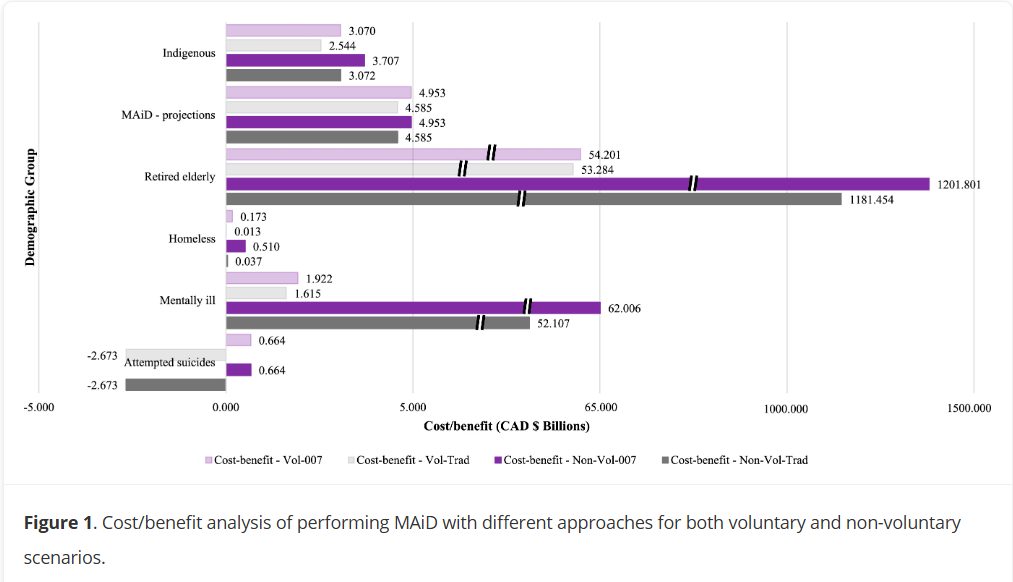
This study explores the potential economic savings from expanding medical assistance in dying (MAiD) in Canada, where it is currently a leading cause of death, to include vulnerable groups that cost the government more than they contribute in taxes. These groups include individuals with severe mental health issues, the homeless, drug users, retired elderly, and indigenous communities. Both voluntary and non-voluntary scenarios were analyzed, projecting total savings of up to CAD $1.273 trillion by 2047. With an estimated 2.6 million deaths in the voluntary scenario, mostly among mentally ill and elderly populations, this cost-saving measure raises significant ethical concerns. Financially incentivizing MAiD could shift healthcare priorities away from providing necessary support, potentially devaluing vulnerable lives and fostering a troubling reliance on assisted death as an economic solution. The findings highlight a need for ethical scrutiny of MAiD policy expansion.
Also refer THE FACE OF EVIL: Canadian Doctors Push to Euthanize Disabled Babies [F3]
In 2021, the Canadian Parliament repealed the requirement that the natural death of those applying for assisted suicide [MAiD] be “reasonably foreseeable”. This took place only five years after the original legislation allowing euthanasia and assisted suicide was passed in 2016. In 2024, legislation was introduced so that euthanasia and assisted suicide would be legal on the grounds of mental health alone in March 2027, whilst a Parliamentary committee in Canada recommended in 2023 that euthanasia be made available for children under certain conditions, and that it be made more easily available for prisoners.
Speaking before Second Reading of Kim Leadbeater’s assisted suicide Bill, Trudo Lemmens, professor of law at the University of Toronto, who initially supported Canada’s assisted suicide and euthanasia law, said “One of the most worrying aspects of the Canadian experiment is it shows that once you start legalising, there is a risk that a significant number of physicians normalise this practice”. “It’s like putting fuel on the fire. I’m not sure it can be easily contained”.
In Canada in 2023, the most recent year for which data is available, 15,343 people died through euthanasia and assisted suicide. This equates to 4.7% of all deaths.