

By the © Australian Medical Professionals’ Society, June 2025
The Australian Government has endorsed two treaties developed by the World Health Organization that, together, will affect the health and wellbeing of the global population. The first of these is the 2024 Amendments to the International Health Regulations (2005)1 agreed to by Health Minister Mark Butler in June 2024. The second is the WHO Pandemic Agreement/Treaty.2 These treaties give the WHO unprecedented influence over key aspects of the population’s health, leading to countries, such as Australia, enforcing medical testing; mandating pharmaceutical treatments, including gene therapies; declaring lockdowns and implementing travel restrictions.
The investigation considered the funding mechanisms of the WHO and the affiliations of the WHO’s top-100 donors for specified purposes. It has been shown that donations are tied to ‘donor interests’ and that donor interests aligned with pharmaceutical interests for the majority of top-100 donors. This creates an opportunity for the pharmaceutical industry to influence WHO decisions with the potential to affect global health policy. It has also been shown that the WHO offers a 3,400% return on financial investments. This raises the possibility that the WHO could put in place measures that financially benefit the industries that favour investors. This could presumably include the pharmaceutical industry, favoured by most of the top-100 donors discussed in this report.
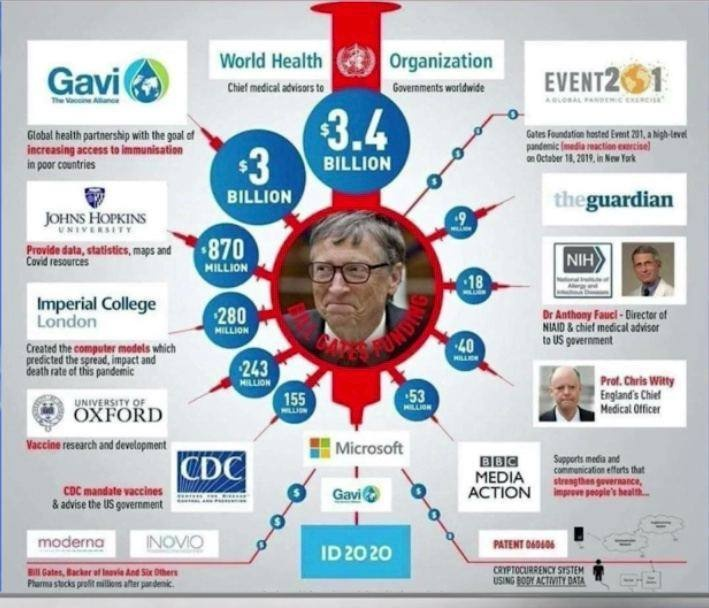
The investigation showed that eight of the 100 top contributors to the WHO’s specified category of voluntary contributions were pharmaceutical companies. Together, these eight companies paid the WHO $28,722,232 in specified donations. Pharmaceutical companies also made donations to the top-100 organisations that donated to the WHO in 2022-2023. The majority of the WHO’s top-100 donors in this period could be broadly categorised as organisations and they included foundations, charities, associations and other organisations. Together, these organisations donated $1,741,237,890 to the WHO for specified purposes.
By far the largest donor was the Bill and Melinda Gates Foundation ($829,502,000), followed by the GAVI Alliance, cofounded by the Bill and Melinda Gates Foundation ($480,872,000). Together, these organisations donated 62.24% of the specified voluntary donations for that period. It was observed that 56 of 58 (96.5%) these organisations had interests that aligned with the pharmaceutical industry to various extents. These ranged from support for pharmaceutical products to collaboration with pharmaceutical companies, investment in pharmaceutical companies and, sometimes, ownership of pharmaceutical companies. Some organisations had links with the pharmaceutical industry at a governance level.
The WHO’s top-100 donors for specified projects included four banks, all (100%) of whom were shown to profit from the pharmaceutical industry: These banks profited by lending funds to countries to purchase vaccines and by lending funds to pharmaceutical companies to develop/manufacture pharmaceuticals. Together, these banks donated $131,820,000 to the WHO for specified projects.
The WHO has put in place funding arrangements that allows donors to determine how their funds are spent. There can be no doubt that this is the case, as it was confirmed by Dr Margaret Chan, former Director-General of the WHO. Chan said, ‘…I tell you, WHO as an organization, only 30% of my budget is predictable funds; other 70% I have to take a hat and go around the world to beg for money and when they give us the money they are highly linked to their preferences, what they like’3 and ‘(m)y budget [is] highly earmarked, so it is driven by what I call donor interests.’4 The fact that the WHO is taking money from donors in return for letting them set their own agenda, gives enormous power to these donors, allowing them to buy their way into the activities of the WHO and potentially influence policy. This is of particular significance when many of these donors are businesses with vested interests.
In accepting money directly from pharmaceutical companies, the WHO contravenes its own Guidelines. The Guidelines on working with the private sector to achieve health outcomes.5 specifically state that the WHO is not to receive funding from commercial organisations that could benefit from its activities.
The investigation shows that the WHO’s current funding arrangements contravene the Organization’s own Guidelines and that serious conflicts of interest exist. This situation greatly compromises the WHO, calling into question both its integrity and the trustworthiness of its decisions. A bias towards the pharmaceutical industry could explain why the WHO’s Amended International Health Regulations and Pandemic Agreement/Treaty further entrench pharmaceutical measures as the answer to any and all public health emergences the WHO chooses to declare. By the power of money, the WHO and the pharmaceutical companies control global health.
- https://www.aph.gov.au//media/02_Parliamentary_Business/24_Committees/244_Joint_Committees/JSCT/2024/Health_regulations/Treaty_Text.pdf ↩︎
- Proposal for the WHO Pandemic Agreement, https://apps.who.int/gb/ebwha/pdf_files/WHA78/A78_10en.pdf ↩︎
- https://www.youtube.com/watch?v=dkqx6fZ6aRs ↩︎
- Fink, Sheri (2014): W.H.O. Leader Describes the Agency’s Ebola Operations. Interview with Dr. Margaret Chan. The New York Times, 4 September, 2014. www.nytimes.com/2014/09/04/world/africa/who-leaderdescribes-the-agencys-ebola-operations.html?_r=0 ↩︎
- World Health Organization, Guidelines on working with the private sector to achieve health outcomes, Report by the Secretariat, 30.11.2000, https://apps.who.int/gb/ebwha/pdf_files/EB107/ee20.pdf ↩︎