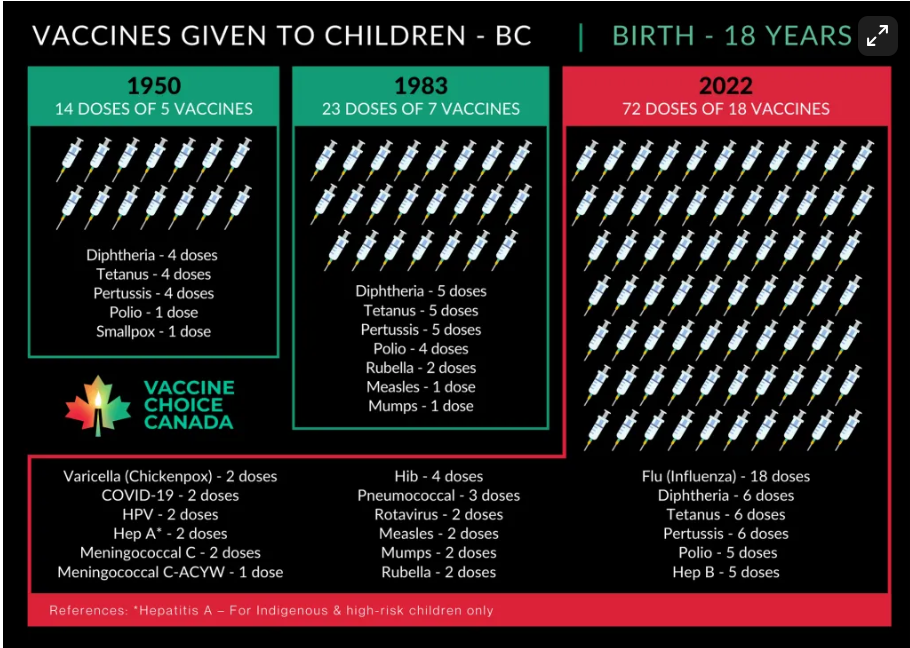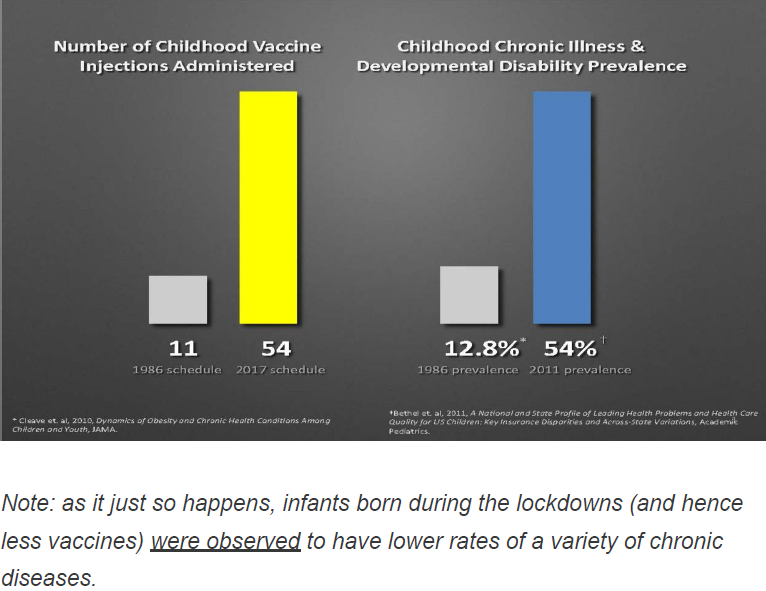
Over the past few decades, the dramatic increase in autism spectrum disorders (ASD), now diagnosed in 1 in every 36 children, has often been attributed to improved definitions for ASD and diagnostic tools. However, a closer look at government statistics reveals alarming trends in children’s health that go far beyond better diagnostics. Since the early 1990s, there have been staggering increases in several chronic conditions: ADHD rates have risen by 890 percent, autism diagnoses by 2,094 percent, bipolar disease in youth by 10,833 percent, and celiac disease by 1,011 percent. These numbers beg the question—what has fundamentally changed in our children’s health over the past three decades?
(A) reliance on ideology over empirical scrutiny extends to vaccine development, where standard double-blind placebo trials, the gold standard for FDA drug approval, are glaringly absent [there are none, for virtually any]. Vaccines such as the hepatitis B shot for infants and the HPV vaccine Gardasil for adolescents have been approved with minimal scientific rigor, yet they are heavily promoted and, in many cases, mandated.
Of note, In the UK, the Childhood Vaccination Schedule (also known as the “Green Book” schedule) is managed by the Department of Health and Social Care (DHSC) and UK Health Security Agency (UKHSA), based on recommendations from the Joint Committee on Vaccination and Immunisation (JCVI). When a vaccine is added to the routine childhood immunisation program in the UK, it provides certain legal, financial, and liability protections to the manufacturer, including Liability Protection Under the UK Vaccine Damage Payment Scheme (VDPS). In the US, where the National Vaccine Injury Compensation Program [VICP] has provided near-total liability protection for approved vaccines since 1986, inclusion in the schedule still offers significant legal and financial safeguards for manufacturers.
The media compounds the issue by amplifying the official narrative while systematically excluding dissenting voices. This failure of transparency has allowed federal health agencies like the CDC, NIAID, and HHS to evade accountability. These institutions, which should safeguard public health, have instead become ideologically and politically captured by private interests. Their close ties to pharmaceutical companies have led to the approval of insufficiently tested vaccines, the pathologisation of normal childhood behaviors, and the delivery of subpar healthcare—all at a staggering cost of $5 trillion annually.